Showing posts with label Rhinoceros. Show all posts

Saturday, August 10, 2013

Sabah in no rush to send rhinos overseas for breeding


KOTA KINABALU: Sabah is in no rush to send its rhinos to zoos abroad for breeding amid fears that the animal faces extinction in Borneo, said state Tourism, Culture and Environment Minister Datuk Masidi Manjun.

He said it would be the state’s last resort to send rhinos overseas for breeding.

“We are looking at all available options and the most important thing is to ensure that these animals will not become extinct,” he said.

“However, to send them overseas will be our last resort,” he said at the Sabah Muslim Cabinet ministers’ Hari Raya open house at Likas Sports Complex on Saturday.

Asked about the growing calls for the near extinct rhinos to be sent to a US zoo for breeding purposes, Masidi said that it was hard to get rhinos to mate due to geographical factors.

“Rhinos are loners. They don’t really move in packs.It makes it much ,more difficult for our rhinos to find mates,” he said.

However, he said he would study various recommendations from experts before discussing with the Cabinet on the options to ensure the species survives in Sabah.

Source: The Star

Monday, June 4, 2012

Malaysia introducing tough new wildlife laws

By the end of the year, Malaysia will begin enforcing its new Wildlife Conservation Act 2010 including stiffer penalties for poaching and other wildlife-related crimes, such as first time punishments for wildlife cruelty and zoos that operate without license.

Dr. William Schaedla, the director of the wildlife-trade monitoring group TRAFFIC Southeast Asia, told mongabay.com that "the new law represents the first major revamp of the national wildlife law in over 30 years." The bill will replace the Wildlife Protection Act of 1972.

To better combat ongoing poaching problems in the Southeast Asian country, penalties have been boosted: killing a Sumatran rhino, a Malay tiger, a clouded leopard, or any protected wildlife will now bring a maximum fine of RM 100,000 (31,000 US dollars) and five years in jail or both if they are female or young. The maximum fine drops to RM 50,000 (15,500 US dollars) for male animals. In addition, for the first time setting snares, hunting, or keeping certain species captive—such as rhinos and tigers—comes with mandatory jail time.


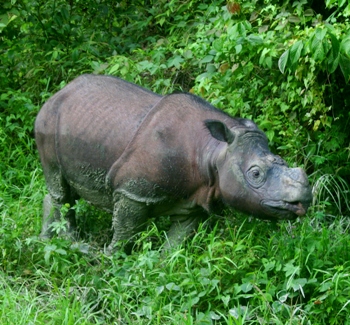
A Bornean rhino, a subspecies of the Sumatran rhino, in captivity in Borneo. Researchers believe there are only some 250 Sumatran rhinos left. Photo by: Jeremy Hance.
"There are areas where the law could be much better organized and tightened, but as it stands, this bill is a vast improvement on the existing law," says Schaedla. "This is because it shows greater recognition of current threats facing wildlife and addresses problems that have plagued enforcement agencies trying to protect wildlife."

For example, the bill also expands protection to more species, including the Asian elephant. Before this new bill, the elephant was considered by Malaysian law as a 'game animal'.

According to the IUCN Red List the Sumatran rhino is Critically Endangered, while the Malay tiger and the Asian elephant are listed as Endangered. These three species are most threatened by poaching, although habitat loss has played a large role in both their historic and ongoing declines. The two clouded leopard species, only recently split into two by taxonomists, are both considered Vulnerable. Although less a poaching target than the other species, clouded leopards are still killed for their coats.

Schaedla says that the success of the new bill in protecting these species will largely depend on implementation. Many countries have stiff penalties for poaching and strong wildlife laws, but fail to catch poachers or punish them with much more than a slap on the wrist.

"How well the new penalties work will depend entirely on how successful enforcement agencies are in bringing poachers and other wrongdoers to justice," Schaedla explains. "The judiciary system must treat wildlife offences as a criminal offence. Offenders must be held liable and be prosecuted to the full extent of the law. For endangered species to be protected, it must be made clear that poaching does not pay."

Schaedla also says that more needs to be done to infiltrate poaching networks: "[Malaysia] should invest more in intelligence led investigations for more effective enforcement. […] More checks at known hotspots throughout the country, at sites that are known to be used as entry-exit points for smuggling wildlife, is needed. To do this, all enforcement agencies—police, customs, army—must work together."

Given that it has taken over thirty years for a new wildlife bill, Shaedla adds that the government should look more frequently at its wildlife trade laws to deal with new situations as they arise.

TRAFFIC is a conservation organization devoted to monitoring the global wildlife trade, encouraging sustainability, and ending illegal trade in species or species' parts.

Wednesday, May 2, 2012

SABAH WELCOMES FUNDING FROM CORPORATE BODIES FOR PRESERVATION OF ENDANGERED SPECIES

KOTA KINABALU, April 15 (Bernama) -- Sabah welcomes funding from corporate bodies for the preservation and rehabilitation of endangered species in the state, specifically the Sumatran rhinoceros.

State Minister of Tourism, Culture and Environment, Datuk Masidi Manjun said although the programme did not have any connection to business, the involvement of such bodies displayed their commitment to a social corporate responsibility towards the environment.

"The Sumatran rhino is among 12 animal species, threatened with global extinction, with just 200 in the wild and 30 having made their habitat in Sabah," he added.

He was speaking at Sime Darby''s Rhino Walk prize giving ceremony in conjunction with the Saham Amanah Malaysia 2012 Week here today.

Masidi praised Yayasan Sime Darby''s move to contribute funds for the animal preservation and rehabilitation programme for some time now, including more than RM11 million for the Borneo Sumatran Rhino Sanctuary, at the Tabin Forest Reserve in Lahad Datu.

He also hoped that the Rhino Walk programme would enhance public awareness towards the importance of the Sumatran rhino and other wild animals apart from the environment, while receiving information on investment opportunities.

Read more: Yahoo! News

Monday, April 16, 2012

Sabah hails funding for endangered species

KOTA KINABALU: Sime Darby, through its foundation, Yayasan Sime Darby has committed RM11.4 million to the Borneo Rhino Sanctuary at the Tabin Forest Reserves in Lahad Datu from 2009 until 2015.

Minister of Tourism, Culture and Environment, Datuk Masidi Manjun praised Yayasan Sime Darby and said Sabah welcomed funding from corporate bodies for the preservation and rehabilitation of endangered species in the state, specifically the Sumatran rhinoceros. He was speaking at the MSAM 2012 Sime Darby Rhino Walk held at the Likas Sports Complex yesterday.

He commented that such efforts should be commended as not many corporate entities are willing to give such a big commitment to causes which are not related or linked directly to the core of their business.

The project is a collaboration with the Sabah Wildlife Department and Borneo Rhino Alliance (BORA) to protect the critically endangered Sumatran rhinoceros.

Based on statistics, only 200 Sumatran rhinoceros are left in the world, out of which 30 are in Sabah and it is declared as one of 12 most endangered animals on earth.

The Sumatran rhinoceros is the world’s smallest rhino species, weighing between 500 to 700 kilograms with the height of 1.2 metres and it has two horns, in contrast to other species of the rhino family.

To some extent, Masidi said, this phenomenon contributes to the uniqueness of Sabah, which is famous for its beautiful natural environment.


Green Sabah says: Hope to see more cooperate bodies willing to fund the preservation and rehabilitation of endangered species in the state! It seems the awareness is getting increase among the people.

Tuesday, January 31, 2012

Rhino heroes earn kudos

They work at a remote rainforest, spending extended periods away from home determined to do their bit to save the critically endangered Sumatran rhinoceros through a captive breeding programme.

It is this dedication that led Borneo Rhino Alliance (BORA) field staff who work under overall supervision of the Sabah Wildlife Department, to assist Department staff in finally capturing elusive female rhino Puntung at the Tabin Wildlife Reserve last month.

Pending tests, Puntung is potentially a mate for Tam, a rhino that walked out of a forest and into a plantation in 2008, and who is now housed at the Borneo Rhino Sanctuary (BRS) captive breeding interim facility in Tabin, over an hour by road from here.

The BORA Management Board led by its chairman Dr Abdul Hamid Ahmad on Friday presented 21 field staff with certificates of appreciation, applauding them for their hard work and willingness to live in a rural location away from family for long periods.

“The successful capture of Puntung required various types of resources, and effort. The most important of all was the hard work over months and years among people working on the ground. Our staff worked at all times in collaboration with Sabah Wildlife Department staff in Tabin.

“At any one time, BORA alone had about 20 people involved one way or another in the capture of Puntung as well as the care of rhinos Tam and Gelogob who were already at the interim facility.

“On behalf of the BORA management, I express my sincere thanks to the staff for their dedication over the past two years. Without their effort, today we would not have Puntung,” Abdul Hamid said in a Press release issued by BORA.

BORA is a non-governmental organisation that is currently assisting the Sabah Wildlife Department in the development of the BRS, a programme of the Sabah Government that kicked-off in 2009 to prevent the extinction of rhinos in Sabah through captive breeding.

The BRS programme aims to bring rhinos from non-viable situations where the mammal exists but is not breeding, to a facility that will maximise chances for reproductive success.

Abdul Hamid said BORA staff are also involved in patrolling and guarding the general area, building and monitoring traps, caring for rhinos and carrying out administrative duties and management of assets.

“Tremendous self discipline is needed to stick with this sort of work and to maintain a harmonious environment,” Abdul Hamid who is also Universiti Malaysia Sabah (UMS) Institute for Tropical Biology and Conservation director, said.

BORA field staff Justine Segunting, 33, said he was proud to receive the certificate and sees it as a recognition that will further encourage him and his colleagues to work on rhino conservation.

“It took us almost two years to find Puntung. I was one of the first staff to see her, and nothing can describe how I felt at that time.

“We worked around the clock from when Puntung was found on Dec 18 (last year) to when she was brought to the interim facility on Christmas day. We sacrificed our Christmas leave, as we could not go home to celebrate, but it does not matter,” Segunting who is from Telupid, about 200km from here, said.
Segunting said he has worked in the forest for eight years including with another NGO and cannot see himself doing anything else.

“This job is my best experience and is something I am passionate about. The survival of rhinos is at stake, and I want to play my part in saving the species,” he said.

Rajimah Kasran, 26, one of only two women involved in field work said it was a relief that Puntung was not captured by poachers who prize rhino horn for traditional medicine.

“We have been tracking Puntung for years and we were worried that poachers might get her. I am so glad that she is now with us and doing well in the interim facility,” she said.

Rajimah of Kampung Dagat in the Segama area, only returns home about five times a year despite monthly leave as all she can think of is her work in rhino conservation.

“When I first started working in Tabin in 2004 through another NGO, I did not know anything about rhinos or why we needed to protect them. Now, all I think about is what I can do to help prevent extinction of rhinos,” she said.

The Sumatran rhino is amongst the most endangered species in the world, and needs urgent and sustained action to prevent its extinction. It is listed as a totally protected mammal under the Sabah Wildlife Conservation Enactment 1997.

Apart from one female in Cincinnati Zoo in the United States, all breeding female rhinos of this species are now known to exist only on the islands of Sumatra and Borneo.
To date, core funding for development and operation of the BRS has come primarily from the Sime Darby Foundation and from the Government, with extra help from WWF-Germany.


Green Sabah says:  The Sumatran Rhino currently only exist in Sumatra and Borneo and its a species that is slowly going extinct. We must take urgent actions in order to preserve them and a good job to all who are involved in protecting and preserving the Rhinoceros.