Showing posts with label Pygmy Elephants. Show all posts

Friday, June 21, 2013

Poisoned food cause death to Bornean pygmy elephants

 
The death of Bornean pygmy elephants at Gunung Rara forest reserve in Tawau early this year is believed cause by toxic constituents that were intentionally added to their food.

State Tourism, Culture and Environment minister Datuk Masidi Manjun said a toxicology analysis by the Queensland Biosecurity Sciences Laboratory, Department of Agriculture, Fisheries & Forestry in Australia discovered from the liver samples of two elephants and a sample of white powder at a location where another elephant was found dead, showed a high level of heavy metal such as arsenic, cadmium, iron and chromium.

Meanwhile, the  findings by pathologists from the veterinary faculty at Universiti Putra Malaysia (UPM) and Thailand suggested that caustic or toxic elements had damaged the elephants' digestive system.

The findings were supported by analysis from the chemistry department of Malaysia and Ramathibodi Poison Centre, Thailand on the elephants' kidneys, spleen and lymphoid tissues although they could not trace the presence of toxic elements.
 
Masidi said the phenomenon is just incomprehensible since the combination of such metals is usually found in mines, foundries, garbage and toxic waste dumping sites whereas there are no activities of such nature in the area.

He said a committee comprising representatives from the Wildlife department, Royal Malaysian Police, state Forestry department, Chemistry department, UPM, state Veterinary Services and Animal Industry department and a few relevant non-governmental organisations (NGOs) was subsequently set up to probe the deaths.
 
The state government had also upgraded the conservation status of the Bornean elephants from a merely 'protected' to 'fully-protected' species under the Wildlife Conservation Enactment 1997.

Commenting on the the negative impact of the incident on the international community, he said the perception was not really accurate as the Bornean elephant population was currently 2,000 and the rate of delivery among the species at conservation such as the Kinabatangan wildlife Sanctuary and Tabin Wildlife Reserve had increased by five per cent.

As for the  RM120,000 reward, Masidi said his ministry through the Wildlife department was still pursuing investigations and maintaining the amount of reward for information.

Saturday, April 20, 2013

Joe, the orphaned pygmy elephant calf is doing well


It has been three months since Sabah Wildlife Department (SWD) sad discovery at Gunung Rara where 14 pygmy elephants were found dead – one of which was Joe’s mother.

The elephant calf, who has since been given nicknamed ‘Joe’ by his caretakers, is healthy and well. All thanks to the love and care of staff and his preferred caretaker, Augustine David.

Augustine said Joe is active and naughty. He is 150kg now, where he gained 50kg since his arrival. He is still nursing and given three litres of milk every two hours.

SWD chief veterinarian Dr Sen Nathan said that ‘Joe’ would probably stay with them for several more years. Efforts to rehabilitate him back to the wild will probably take place when he is about five years old or six.

Sen said this would be the first elephant rehabilitation programme in Sabah and they could not guarantee if it will be successful. Currently, Joe probably thinks he is more human than elephant since he is cared for by a human thus it will be difficult to rehabilitate him to the wild.

The elephant rehabilitation programme will take place at the Borneo Elephant Sanctuary in the Kinabatangan.

Thursday, April 18, 2013

Sam: Speed up probe into death of elephants


KOTA KINABALU: Sahabat Alam Malaysia (Sam) is concerned over the slow progress of investigation into the death of the 14 pygmy elephants at the Gunung Rara Forest Reserve in Sabah in late January.

Until today, no results or findings have been released. The authorities have yet to determine whether they were poisoned deliberately, said Sam president S M Mohd Idris.

“How long does it take for experts to obtain answers to the death of the elephants?” he asked.

Sam calls on the Sabah Tourism, Culture and Environment Minister and Wildlife and Natural Parks Department to release their findings as the public has a right to know the cause of the deaths.

“With the threat to wildlife in our forests, what percentage of elephant habitat remains? Even the fate of protected forests remain uncertain as they can be converted into reserves with a large chunk filled with new settlements, villages and agricultural land. Traditionally such tracts have been routes through which elephants have roamed,” said Idris in a statement yesterday.

In the case of oil palm plantations, he said they are often adjacent to wildlife habitat and the only routes available for elephants are through villages and fields of farmers, who bear the brunt of the conflict.

With so much land devoted to plantations, the elephants’ natural habitat has shrunk, he said.

As a result, an increasing number of elephants are entering newly developed areas and incurring the wrath of plantation companies, farmers and villagers, the consequence of which is death by poisoning, he added.

“We hope the authorities are conducting an in-depth investigation to prevent a recurrence.

“Efforts to improve the balance between the needs of elephants and an ever-expanding plantation sector, plus a growing human population, have to be taken seriously,” he said.

Idris also said there is a need to reduce the level of conflict between human activities and elephants, and enhance community engagement in the conservation of elephants and their habitat.

He pointed out that poisoning of elephants is the most cruel form of treatment carried out by those whose only intent is to avenge the loss of crops without understanding that elephants need space to move.

“Sam looks forward to the results of the investigation and we call on the authorities to step up their probe into finding those responsible for the death of the elephants, and for them to be penalised,” he added.

Source: Borneo Post

Wednesday, March 27, 2013

'Baby Joe' is doing fine at wildlife park

Photo: Andrew Chant

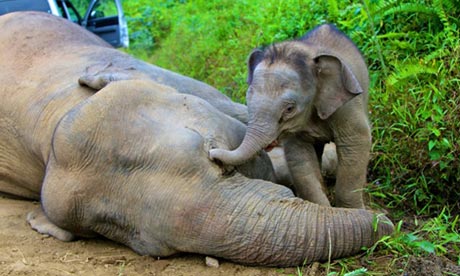
KOTA KINABALU: JOE, the elephant calf, which captured the hearts of all when a photograph of it trying to wake its dead mother was published, is doing fine.

Two months down the line, the four-month-old calf has gained weight and is also more sociable with other elephants at the Lok Kawi Sabah Wildlife Park, near here.

Sabah Wildlife veterinarian Dr Roza Sipagkui said seeing other elephants could psychologically motivate baby Joe to move on with its life despite its loss.

"During the first day, it was brought here, it looked traumatised so knowing that there would be other animals here can help it to familiarise itself," she added.

However, the calf is still being monitored as they could not be sure whether the "poison" is completely removed from its internal system.

"Baby Joe drank its mother's milk. It could possibly be also be poisoned," she said.

The calf has gained weight after being fed baby formula by hand. It has also began taking in solids in the form of grass and soft parts of banana tree trunk.

Roza said that baby Joe would continue to stay at the park until they were sure that it was capable of taking care of itself in the wild.

Baby Joe hit the headlines when it was pictured nuzzling its lifeless mother in a desperate attempt to revive her.

Baby Joe's mother was among 14 pygmy elephants found dead at the Gunung Rara Forest Reserve in Tawau.

State Tourism, Culture and Environment Minister Datuk Masidi Manjun said the outcome of the second test result would be revealed next week.

"We will wait for the test report and further action will be taken based on the facts," he added.

The result of the first test on the elephants' deaths proved to be inconclusive. A sample was sent to forensic testing facilities in Australia and Thailand in an effort to find any chemical compounds that may have caused the deaths of the pachyderms.

Friday, March 1, 2013

10 elephants rescued in Lahad Datu

One of the two collared elephants known as Bikang 1. After her release, Bikang 1 started a long trek of more than 100 km deep into the Tabin Wildlife Reserve forest.

While the shocking death of 14 Borneo Pygmy Elephants was still fresh in the people's memory, the rescue of ten others in Lahad Datu provided some relief. 

The ten elephants were rescued by the Sabah Wildlife Department between 18th and the 25th of January, when it became known that they had ventured more than 45 km from their original habitat at the Tabin Managed Elephant Range and to an area a mere 10 km away from Lahad Datu town.

"We received a call from a man from Sri Tungku Simpang Ladang Permai, near Lahad Datu, complaining that elephants were roaming near his house," explained Jibius Dausip, senior officer from the Wildlife Rescue Unit.

A team was dispatched to the location where they found a herd of ten elephants  - 9 female of various ages and one young male of about 4 years old. Jibius confirmed that the group was most likely a family group.

Wildlife veterinarian from the Wildlife Rescue Unit (WRU) and the Danau Girang Field Centre, Dr Diana Ramirez said that all 9 female elephants have been herded back to Tabin Wildlife Reserve. She added that two of the biggest females in the group were fitted with satellite collars provided by the Danau Girang Field Centre.

One of the elephants,  a young male had a bad injury on its trunk and was transferred to the Lok Kawi Wildlife Park where it receives treatment.

Ramirez explained that without captive intervention, the injured elephant had a slim chance of survival in the wild.

The translocation of the elephants had to be done in stages as releasing them in one go would pose logistical problems.

Senior Wildlife Officer and WRU Manager Dr. Senthilvel Nathan disclosed that his team is currently studying the possibility of releasing future translocated herds together to prevent the herd from separating.

"That might cost more and it would be logistically more challenging because we would need to set up a pre-release holding area and renting more transporting lorries. But our main concern is the elephants' welfare and keeping the group dynamic intact," he said.

Director of Danau Girang Field Centre Dr Benoit Goossens explained that extensive agriculture through plantations such as palm oil has considerably reduced the habitat of the elephant and other wildlife in Sabah. This has led to an increase in human-elephant conflicts.

"The recent deaths of 14 elephants are most likely a result of human-elephant conflict in elephant ranges and there is an obvious need to better manage the landscape within and around the plantations by providing routes for wildlife to move from one forest to another," added Goossens.

According to Goossens, after one month of satellite monitoring, the two collared female elephants have roamed in the reserve and have not yet ventured into plantations around Tabin.

"If they ever return to the vicinity of Lahad Datu, we will be able to analyse their migratory pattern and advise the plantation owners how to fence their land to avoid any more intrusion," he said.

Elephant translocation is part of a long-term programme that the Sabah Wildlife Department and Danau Girang Field Centre launched last year to tackle human-elephant conflicts in agricultural plantations such as palm oil.

Funding is currently provided by The Asian Elephant Foundation and the Mohamed bin Zayed Species Conservation Fund.

The Danau Girang Field Centre is a collaborative project between the Sabah Wildlife Department and Cardiff University.

Source: Insight Sabah

Tuesday, February 26, 2013

Don’t speculate on pygmy elephants’ deaths – Masidi

Photo: runwildrunfreefilms.blogspot.com

KOTA KINABALU: Members of the public have been asked not to jump to conclusion on the cause of death of the 14 pygmy elephants in Lahad Datu.

Tourism, Culture and Environment Minister Datuk Masidi Manjun told press members after addressing his ministry’s monthly staff gathering yesterday that it was dangerous for them to come up with an assumption at this time unless there was strong evidence to support their argument.

“We cannot assume because the first test conducted failed to show how the elephants had died,” he said.

He added that a lot of people had mentioned the possibility that the elephants were killed by oil palm plantations.

“But the elephants died 42 kilometers from the nearest plantation. That is very far away. So anything could have caused their deaths,” he said.

Masidi also said it was wrong to point fingers at village folk as the culprits.

When asked if it was possible that the elephants could have been poisoned by pesticides gotten from Indonesia,, Masidi replied that if pesticides were used in the killing of the elephants, it would have been apparent in the first test carried out.

“It would have been found in the lab test … if it was pesticide, other animals would have been found dead near the locations too. But there were none. Moreover, half of the elephants from the same herd are still alive. If it is true that they had grazed at the same areas, all of them would have been dead,” he explained.

Masidi added that he did not think the pesticide was dumped into the river because otherwise they would have found dead fishes too.

Meanwhile, the samples from the dead elephants have not been sent to laboratories in Australia and Thailand as the issue is governed by the Convention on International Trade in Endangered Species (CITES).

“We have to wait for their approval before we can send the samples to Australia and to Thailand. CITES is responsible on such issues. Moreover, the pygmy elephants are classified under Class 1 of CITES, so we need their approval before we can ship the samples outside of Sabah. We will be getting the approval to send the samples over to Thailand but the approval to send the samples to Australia is still pending,” he said.

Fortunately, the samples, which were refrigerated, can last for a long time, even years.

He stressed that they were keen on resolving the issue as soon as possible as it has garnered world attention.

Masidi then mentioned that there was still no tip-off from the public despite the RM100,000 reward that was now being offered for the capture and conviction of the perpetrator that had caused the elephants’ death.

“Even the police, who have tried their best, have yet to find any lead on what killed the elephant. It is a mystery, so we need to tackle the issue with caution. We don’t want to accuse people unnecessarily.

“Give them time. We hope there will be concrete evidence on the cause of death. I must caution however than not all scientific knowledge can solve problems.”

Read more: Borneo Post

Sunday, February 17, 2013

Pesticide poisoning killed elephants

Pesticide poisoning likely killed 14 elephants in Sabah last month.

THE 14 pygmy elephants which died mysteriously at the Gunung Rara reserves last month are likely to have died from pesticide poisoning, according to research carried out by the Borneo Conservation Trust (BCT).

BCT found chemicals such as cyanide and sulphur at the site where the elephants were found, but is unsure whether the poisoning was deliberate.

BCT conservation and research head Raymond Alfred said traces of both chemicals could have contaminated the animals' food sources near the area.

"Cyanide could be traced to certain pesticides that are used to increase the growth of young oil palm trees, while sulphur is normally used by local hunters or Indonesian workers hunting wild boars at the edge of plantations adjacent to the forest," he said.

"However, no concrete evidence has been gathered to show that the elephants were poisoned by the plantation during their encroachment or presence along the Ulu Sungai Napagon and Imbok River at the area where the elephants were discovered," he said.

"And there is also no concrete evidence showing that the logging contractors were using high amount of pesticides to kill the elephants at the Gunung Rara Forest Reserve, although white substances were found within the vicinity where the elephant corpses were found," he stressed.

Alfred added that elephants were very alert creatures and could smell poison.

He explained that elephants entered the plantations within the Gunung Rara and Kalabakan reserves to gain access to water and a saltlick.

Non-functioning electrical fences set up by the plantations involved have also allowed the elephants easy access into the plantations, he pointed out.

Alfred suggested several possible solutions to address the issue, including restoring and expanding the riverine forest, as well as preserving as many virgin and lowland secondary forests as possible.

He said the major threats Bornean elephants face are the degradation and fragmentation of their habitat.

This raises the risk of genetic isolation from other elephants, particularly when traditional seasonal migratory routes are blocked.

The fragmentation of elephant habitat has also led to the increasing number of human-elephant conflicts at Lower Kinabatangan, Alfred said.

To counter the issues faced by the elephants, Raymond stressed the need to establish forest corridors and strengthen existing ones.

"The corridors don't necessarily have to be established at prime elephant habitats. It could be established at degraded forest areas to facilitate elephant movement and to provide the elephants with some cover," he said.

"In forest reserves, priority is given to the elephants' requirements, but compatible human activities, such as sustained-yield forestry and slow rotation of timber harvesting programme, can also contribute to creating a good habitat for elephants as re-growth and secondary vegetation often provide excellent food resources and are capable of maintaining higher elephant densities than primary forests."

Alfred said that BCT and the Sabah Wildlife Department are currently preparing a programme where every plantation had to to establish a wildlife conservation unit.

It will run five to 10 years will help manage multiple-use forest landscapes and monitor the elephant population.The Star/ANN

Source: Brunei Times

Friday, February 15, 2013

WWF: Long-Term Solutions Needed for Conservation of Borneo Pygmy Elephants

Pygmy elephants

WWF-Malaysia is concerned about the recent pygmy elephant deaths in the Gunung Rara Forest Reserve.
 
“WWF-Malaysia is providing support to the Sabah Wildlife Department and is part of the special taskforce that has been set up by the Department to further investigate the matter. Our patrolling teams worked closely with the Department in unearthing the incident,” said WWF-Malaysia Executive Director/CEO, Dato’ Dr Dionysius S K Sharma.

According to reports, all the deaths have happened in areas where forests are being converted for plantations within the permanent forest reserves.

“The central forest landscape in Sabah needs to be protected totally from conversions. All conversion approvals need to be reviewed by the Sabah Forestry Department and assessed not purely from commercial but the endangered species and landscape ecology perspectives”, Dr Dionysius said.

“Conversions result in fragmentation of the forests, which in turn results in loss of natural habitat for elephant herds, thus forcing them to find alternative food and space, putting humans and wildlife in direct conflict”, he added.

Holistic long-term solutions need to be put in place to address and mitigate the problem, Dr Dionysius said.

He said that elephants need to be elevated to a ‘totally protected’ status under Part 1 of Schedule 1 of the Wildlife Conservation Enactment of Sabah, which has been recommended in the Sabah Wildlife Department’s Elephant Action Plan 2012-2016, but yet to be implemented.

“Frequent and large scale patrolling is critical to avoid such conflict from happening again. However, given the vast area that requires patrolling, it is a massive task for the Sabah Wildlife Department. More resources, including manpower, hardware and finances, should be allocated for the Department. The existing honorary wildlife warden programme of the Department is doing well and should be expanded,” Dr Dionysius said.

The Borneo pygmy elephants are an endangered species. There are approximately 1,200 of these evolutionarily unique elephants in Sabah and all of Borneo. Ten carcasses of the endangered elephants were found dead within the central forests of Sabah which is also a part of the Heart of Borneo.

Source: ecoseed.org 

Wednesday, February 13, 2013

More comprehensive tests and analyses to be carried out over elephants death


Death of 14 Pygmy elephants is still under investigation

Minister of Tourism, Culture and Environment Datuk Masidi Manjun said his ministry will be seeking a second opinion from two internationally accredited forensic testing facilities – the Ramathibodi Poison Centre at Mahidol University of Thailand and to the Chemistry Lab of the Queensland Government Department of Agriculture, Fisheries and Forestry, Australia for comprehensive tests and analyses over the elephants death.

Sabah Forestry Director Datuk Sam Manan said apparently Yayasan Sabah has been blamed for the deaths of 14 pygmy elephants in Gunong Rara Forest Reserve because their oil palm plantations were being destroyed and being nearest to the scene even though the investigation has not been concluded. Chemistry and Forensics Departments have not yet yield any conclusive evidence for analysis on the samples taken from the elephant carcasses. Therefore, Masidi has instructed that the scope of tests be widened to more possible contaminants. Analysis results from the two internationally accredited forensic testing facilities hopefully will ensure greater transparency over this investigation.

Thursday, February 7, 2013

Sabah police identify logging companies at site of pygmy elephants' death

Pygmy elephant
KOTA KINABALU, Feb 6 (Bernama) -- Sabah police have identified the logging companies carrying out works at the site where 14 Borneo Pygmy elephants died mysteriously at the Rara Forest Reserve, about 139km from Tawau, recently. 

Sabah police commissioner Datuk Hamza Taib said, investigations have revealed that there were logging companies with 300 workers present at the said location. 

"The Criminal Investigation Department is in the process of completing the investigation. We know that the place is remote but we also know which companies are working there," he said during a press conference at the Sabah headquarters, here today. 

On Feb 1, police started investigating the case under Section 429 of the Penal Code for mischief towards animals, which is punishable by up to five years in jail. 

He added that they did not discount the possibility that the elephants were poisoned as the dead animals were found with their stomachs ruptured. 

"We have to wait for the chemist report to establish if it was poisoning and only then continue our investigation," he said. 

He believed that the case would be solved after the chemist report and the RM50,000 reward for information leading to its resolution. 

Yesterday, Sabah Tourism, Culture and Environment Minister Datuk Masidi Manjun said an additional RM40,000 would be offered for information leading up to the arrest of the parties responsible for the endangered species death. 

Earlier, the Malaysian Association of Tour and Travel Agents (MATTA) had put up a RM10,000 reward for the same purpose.

Source: mysinchew.com

Tuesday, February 5, 2013

Sabah offers RM40,000 reward

.
Wildlife and Natural Parks Department officer Augustine David with the sole survivor of a herd of Borneo pygmy elephants found dead in the Gunung Rara Forest Reserve recently. Pic by Lano Lan

KOTA KINABALU: IF the chemist's report indicates that the 14 Borneo  pygmy elephants were poisoned, the state government will offer a RM40,000 reward for information leading to the arrest and conviction of the culprits.

State Tourism, Culture and Environment Minister Datuk Masidi Manjun said yesterday the chemist's report would be ready on Friday.

At a task force meeting on Monday, he was told that two senior police officers from Kinabatangan had been assigned to investigate the matter.

"The Malaysian Association of Tour & Travel Agents (Matta) has offered RM10,000 and they (task force) have asked the ministry to top it up.

"I found that there is a provision for this in the Wildlife Enactment and I agreed to top it up with another RM40,000. So the potential reward is RM50,000."

All eyes have been on Sabah since news of the death of 14 elephants near the Gunung Rara Forest Reserve, 130km from Tawau, was published.

The Sabah Wildlife and Natural Parks Department believes that the endangered mammals were poisoned. It submitted samples to the Chemistry Department last week.

"Once the chemist's report is ready and if it shows conclusively that someone poisoned the elephants, we will start sending flyers to let people know about the reward.

"We are not saying that the elephants were poisoned. We are saying if the chemist's report confirms it, we will start looking for the culprits."

Friday, February 1, 2013

Joe, the baby elephant is well and healthy

Joe, the baby elephant


KOTA KINABALU: The orphaned baby elephant rescued from a herd of 13 that were found dead in Tawau appears well and healthy at the Lok Kawi Wildlife park here.

It was renamed "Joe" as its earlier name "Kejora" was considered feminine by the team from the Sabah Wildlife department Rescue Unit who are tasked to look after the male Bornean Pygmy elephant round the clock for at least two more weeks.

Since Joe was found next to its dead mother on Jan 25, it was looked after by members of the unit who thereafter brought it from the scene near the Gunung Rara Forest Reserve about 130km from Tawau and transported to the park where it could be better monitored.

Datuk Seri Panglima Haji Musa bin Haji Aman

Meanwhile Chief Minister Datuk Seri Musa Aman ordered the State Wildlife Department and Forestry Department to thoroughly investigate the death of the elephant.

“This is unacceptable. The culprits must be brought to justice,” he said adding that the State Government viewed this matter seriously as Bornean Pygmy elephants were an endangered species.

He said that these elephants were part of Sabah’s rich and exotic wildlife and should therefore be protected.

“People come from all over the world just to catch a glimpse of these animals.  It is unfortunate that there are people who would resort to such a horrific act, “ he said.

Yayasan Sabah pledges cooperation in probe of dead elephants

Pygmy elephants' death to be investigated


KOTA KINABALU: Yayasan Sabah Group will cooperate with the relevant departments in investigating the cause of death of the elephants at its concession area, said Yayasan Sabah director Tan Sri Datu Khalil Datu Jamalul.


He said the Group would work closely with the relevant agencies to find the root cause of the dead elephants and to come up with corrective actions to avoid similar incidents in future.

“In fact, we are part of the Task Force comprising various government departments and agencies set up to investigate the incidents,” he said in a statement, here today.

Yesterday, State Minister of Tourism, Culture and Environment Datuk Masidi Manjun was quoted as confirming that so far, 14 Borneo pygmy elephants had been found dead at the Rara Forest Reserve, about 139km from Tawau.

Masidi had said based on an initial examination of the elephant carcasses, the cause of death was likely to be poisoning.

Khalil also clarified that Syarikat Empayar Kejora Sdn Bhd was not a subsidiary logging company of the Group as purportedly reported in the dailies but a contractor contracted by the Group to undertake responsible logging activities within the area.

All logging contractors under the purview of the Group are stringently bound to the relevant Acts and Enactments including the Forest Enactment (1968), Wildlife Conservation Enactment (1997), Sabah Biodiversity Enactment (2000) and the Environmental Protection Enactment (2002), he said.

 “We are also working closely with many government agencies and national as well as international bodies and NGOs such as the Royal Society of United Kingdom; WWF Malaysia, Face the Future, the Netherlands; IKEA, Sweden; Wetlands International, Forest Research Institute Malaysia, Forest Research Centre Sepilok, Academy Sciences Malaysia, Universiti Malaysia Sabah, PETRONAS, Kyoto University and many others for our forest management, environment, conservation and rehabilitation, environmental education and community outreach programmes,” he added.

Khalil said the group would continue to play a critical role in ensuring that the environment remains available for future generations.  

On this note, he said the Group would not rest on its laurels on issues concerning environmental sustainability.

"Therefore, the Group will work together with other agencies to prevent unwanted incidence like these from happening again especially in our own concession area,” he said. 

Pygmy’s killer must be brought to justice

Pygmy elephants

KUALA LUMPUR: The Malaysia crime Prevention Foundation (MCPF) has expressed full support to the statement by Sabah’s Tourism, Culture and Environment Minister Datuk Masidi Manjun that if the Bornean elephants were maliciously poisoned then the culprits must be brought to justice and be made to pay for their crime against these animals.

“The shocking discovery of the mysterious deaths of 13 Borneo pygmy elephants in Gunung Rara Forest Reserve is indeed the saddest day for Sabah’s conservation efforts,” MCPF Vice Chairman, Tan Sri Lee Lam Thye said in a statement yesterday.

“As an animal lover I am also deeply saddened by the death of these majestic and endangered Bornean elephants,” he said. “The picture of an orphaned elephant calf trying to wake up its dead mother was indeed a heart wrenching sight and would move animal lovers to tears,” he added.

Lee welcomed the setting up of a taskforce by the Sabah Wildlife Department involving the WWF and the police to investigate and get to the bottom of this tragic incident.

He said the authorities concerned must send a strong message to those responsible for the death of the endangered species that their action must not be tolerated and they must be brought to justice.

“Granted that these elephants might roam into plantations and villages where they might cause losses to the owners, such a problem, if it does exist, can be dealt with by the Wildlife Department.

“But if there are humans who go to such extent to kill the 13 endangered pigmy elephants by resorting to poisoning, it is totally unacceptable and justice must be done,” he said.

“According to media reports it would appear that the likely cause of death pointed to poisoning as according to the post mortem the gastro intestinal tracts had severe hemorrhages and ulceration with some bleeding from the mouth and anus,” Lee said.

“If any form of poison is used to kill the elephants leading to their slow and painful deaths, then it is an act of sheer cruelty to the animals which must be taken seriously and those responsible must be brought to book,” he said.

Source: New Sabah Times

Masidi: Death of 10 elephants saddest day for conservation efforts in Sabah

Baby pygmy elephant mourns over dead mother

KOTA KINABALU: The discovery of the deaths of 10 Borneo pygmy elephants in Gunung Rara Forest Reserve was the saddest day for Sabah’s conservation efforts.

“This is a very sad day for conservation and Sabah. The death of these majestic and severely endangered Bornean elephants is a great loss to the state,” Tourism, Culture and Environment Minister Datuk Masidi Manjun  said.

“Though it might be too early to pinpoint a conclusive cause of death, poisoning seems to be the likely cause,” he said.

Masidi said he had directed Sabah Wildlife Department to set up a joint task force with relevant stakeholders such as the Forestry Department, Yayasan Sabah, WWF and police to further investigate these deaths and to get to the bottom of it.

“If indeed these poor elephants were maliciously poisoned I will make sure that the culprits are brought to justice and pay for their crime ” Masidi added.

Elephants are known to roam into plantations and villages where they cause severe losses to the owners.

Sabah Wildlife Department is usually called in to help in steering the elephants away from such places and in some cases they are moved to other forest reserves.

However, some people affected have resorted to poisoning the elephants to stop their menace and among the methods used are pesticides including rat poisons over the years.

State Wildlife director Datuk Dr Laurentius Ambu  said that they were scouring the Gunung Rara Forest Reserve area as well as places adjacent to it to see if any pesticides were used to kill the elephants.

Tuesday, January 29, 2013

10 rare pygmy elephants found dead in Sabah

A baby elephant stays close to a dead pygmy elephant in the Gunung Rara Forest Reserve, some 130 kilometers from Tawau in Malaysia's Sabah state. AFP

KUALA LUMPUR (Jan 29, 2013): Ten endangered pygmy elephants were found dead this month in Malaysian Borneo and are thought to have been poisoned, conservation officials said Tuesday.

Wildlife authorities in Sabah, a state on the eastern tip of the island, have formed a taskforce together with the police and WWF to investigate the deaths.


Laurentius Ambu, Sabah wildlife department director, said it received a report last Wednesday of four dead pygmy elephants in the Gunung Rara forest reserve.


But officials were "shocked" to find another four of the animals, a rare sub-species of the Asian elephant, dead or dying after inspecting the area for two days, he said.


"Early this year, two highly decomposed elephant carcasses were found in the general vicinity of where these eight animals were found. We believe that all the deaths of these elephants are related," he said in a statement.


Sen Nathan, the department's senior veterinarian, said in the statement "we highly suspect" the animals died due to poisoning after finding severe ulceration and bleeding in their digestive tracts.


"It was actually a very sad sight to see all those dead elephants, especially one of the dead females who had a very young calf of about three months old. The calf was trying to wake the dead mother up," he said.


Masidi Manjun, the state's environment minister, vowed to take tough action.


"If indeed these poor elephants were maliciously poisoned I would personally make sure that the culprits would be brought to justice and pay for their crime," he said in the statement.


There are fewer than 2,000 Borneo pygmy elephants, which are smaller and have more rounded features compared to normal Asian elephants, left in the wild, according to authorities. 


Activists warn that pygmy elephants are fast losing their natural habitat to deforestation and human encroachment on Borneo, a vast island shared by Malaysia, Indonesia and Brunei. – AFP

Source: The Sun Daily

Monday, July 2, 2012

Malaysia Saves Endangered Pygmy Elephant on Borneo

Pygmy-elephant-calf-625x450 


Kuala Lumpur, Jan 23, 2012 (AFP) - Malaysian wildlife authorities said Monday they had rescued a pygmy elephant calf on Borneo island and expressed hope a planned sanctuary would provide protection for the endangered animals.
  
The male calf, which is less than a month old, was pulled out of a deep moat surrounding a palm oil plantation in remote Sabah state on Friday, said Sen Nathan, a senior official with the Sabah Wildlife Department.
  
It is the fifth calf rescued by wildlife officials since 2009. Three of those previously saved have died but a female has recovered and is now at a wildlife park.

[Quiz Yourself: How Much Do You Know About Pygmy Elephants?]
 
There are fewer than 2,000 Borneo pygmy elephants left in the wild, according to authorities. A sub-species of the Asian elephant, the creatures have a rounded appearance and are smaller than mainland elephants.
  
The latest rescued calf, which weighed about 50 kilograms (110 pounds), was in a serious condition, Nathan told AFP.
  
"He suffered severe dehydration and cuts and abrasions, probably while trying to get out of the moat," he said.
  
The elephant's mother was probably forced to leave it behind after the pair fell into the moat, and the calf likely spent more than a day there before being spotted by plantation workers, he said.
  
Nathan said a planned elephant sanctuary on 1,200 hectares (3,000 acres) of land within the 26,000-hectare Kinabatangan wildlife sanctuary in Sabah would help protect the animals.
  
The sanctuary would be able to house up to 60 injured elephants, as well as those found when they were too young to be reintroduced into the wild.

[Learn More About Pygmy Elephants]
  
Authorities announced plans for the sanctuary earlier this month and want it open by the end of the year. "We really need this sanctuary," Nathan said.
  
The sanctuary will be funded with 5.3 million ringgit ($1.7 million) from industry body the Malaysian Palm Oil Council and 1.5 million ringgit from NGO the Borneo Conservation Trust.
  
Wildlife activists warn that pygmy elephants are fast losing their natural habitat to deforestation and human encroachment on Borneo, a vast island shared by Malaysia, Indonesia and Brunei.

Source: http://blogs.discovery.com/animal_news/2012/01/malaysia-saves-endangered-pygmy-elephant-on-borneo.html

Friday, May 11, 2012

Collared elephant provide hope in finding vital corridors in fragmented habitat

A female Borneo pygmy elephant recently fitted with a satellite collar is expected to become her herd’s ambassador in determining important migration corridors between forested areas currently cut off by development, including the Sandakan-Lahad Datu road.

The collar on the 1.9-metre tall elephant captured in the Segaliud Lokan Forest Reserve is expected to transmit data on possible further migration into the Pin Supu Forest Reserve, or from the Lower Kinabatangan region to Segaliud Lokan.

Borneo Conservation Trust (BCT) Conservation and Research head Raymond Alfred said the estimated 290 to 310 elephants in the Kinabatangan region are currently separated from the main population in central Sabah, including the Segaliud Lokan Forest Reserve, by a main road.

Alfred said the solution to habitat fragmentation lies in the creation of a network of wildlife “corridors” that link forest reserves.

“This collaring activity is one of the components of the Mega Biodiversity Corridor programme initiated by BCT, which aims to enhance forest ecosystem connectivity and ecological corridors within key habitats of the Bornean elephant and Orang Utan in Sabah.

“The Mega Biodiversity Corridor will allow elephants and Orang Utan to safely migrate, access food sources and establish crucial genetic links between populations,” Alfred said in a joint statement issued by BCT and the Sabah Wildlife Department here today.

The elephant named “Segaliud” is estimated to be between 25 and 35 years old. She was observed to be physically healthy and was in lactation with a calf of around five to six months old.

The collaring exercise is the first to be carried out by BCT and the Sabah Wildlife Department’s Wildlife Rescue Unit in collaboration with KTS Plantation Sdn Bhd.

Alfred said there was a need to develop a long-term action plan to address the issue of fragmentation.

“Steps may include land purchase and the securing and restoration of riparian reserves (at river banks) to re-establish the vital wildlife corridors that link key habitats and protected areas,” Alfred said.

Sabah Wildlife Department director Dr Laurentius Ambu said the department is working closely with BCT and its partners from the private sector to reinstate and maintain crucial elephant corridors.

“Wildlife corridors offer one of the best long term solutions facing the endangered Bornean elephant,” Ambu said.
According to the Elephant Action Plan recently released by the department, there are an estimated 2,040 elephants in Sabah.