Showing posts with label proboscis monkey. Show all posts

Monday, July 30, 2012

Warrior names for collared proboscis monkeys

KINABATANGAN: Two male proboscis monkeys were given warrior names after they were fitted with tags by the Sabah Wildlife Department’s (SWD) Wildlife Rescue Unit (WRU) and Danau Girang Field Centre (DGFC).

Jibius Dausip from WRU and the expert darter of the team, explained the two animals collared in Menanggul tributary and on the Kinabatangan river, near Sukau, weighed 23 and 19 kgs, respectively, and were named Monso (short for Monsopiad who was a Kadazandusun warrior and a famous headhunter) and Gambu (short for Gambunan who was a Dusun group leader from Tambunan).

Danica Stark, PhD student at Cardiff University and DGFC, said the aim of the satellite tagging programme is to understand the ranging patterns of proboscis monkeys and the factors impacting their movements and density in order to determine the adequate amount of habitat available in order to sustain a continuous viable population in the Kinabatangan region.

“As the collars record locations automatically, it is collecting movement data that is completely natural and not influenced by human presence.

“Moreover, the collars are set with a drop-off and therefore the monkeys will not wear them forever.
The drop-off is set to release the unit after 52 weeks,” added Danica.

DGFC director Dr Benoit Goossens said the project was funded by Sime Darby Foundation (Malaysia) and Margot Marsh Biodiversity Foundation (USA).

“The support for the palm oil industry is extremely important.

Yes, mistakes have been made in the past, like in every country in the world during their economic development, but it is never too late to realise where we have been wrong and I believe that in Sabah the industry, the government, NGOs, wildlife conservationists and local communities can work together to make a better environment for our wildlife,” said Goossens.

SWD director Dr Laurentius Ambu said this project is extremely important for the conservation of the proboscis monkeys in Sabah.

One of the main outputs of the programme will be the first State Action Plan for the species and its launching at an international workshop on the conservation of proboscis monkeys in Borneo that will be organised in Kota Kinabalu in two or three years.

Source: http://kepkas.sabah.gov.my/2012/06/12/warrior-names-for-collared-proboscis-monkeys/

Thursday, June 7, 2012

Labuk Bay Proboscis Monkey Sanctuary


The Best Place to See Endangered Proboscis Monkeys in Sabah, Borneo

The Labuk Bay Proboscis Monkey Sanctuary in Sabah, Borneo is 400 acres of privately-owned land which has been set aside as a refuge for endangered proboscis monkeys. Around 60 monkeys call the Labuk Bay Proboscis Monkey Sanctuary home. The mangrove forest, originally targeted to be developed commercially, was set aside in 1994 and then opened to the public later. With most of their native habitat in Sabah consumed by palm oil plantations, the proboscis monkeys would have little chance to survive without the refuge.
While seeing endangered orangutans is a highlight for many visitors to Borneo, even fewer proboscis monkeys remain in the wild.

A Little About Proboscis Monkeys

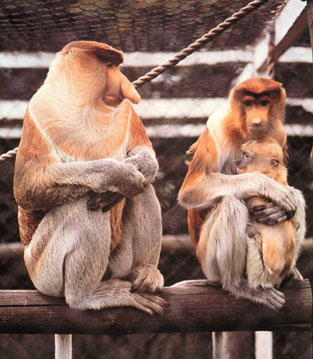
One of the strangest and most endangered primates in the world, people never forget seeing proboscis monkeys for the first time. Native only to Borneo, the pot-bellied, floppy-nosed proboscis monkey has been red-listed on the IUCN List of Threatened Species. Sadly, less than 7,000 proboscis monkeys are thought to be left in the wild. Only 2,000 monkeys still survive in Sabah, mostly due to habitat loss.
Proboscis monkeys are highly reclusive; spotting one in the wild is challenging. The Labuk Bay Proboscis Monkey Sanctuary gives visitors a chance to see protected proboscis monkeys in a semi-wild environment. The Bako National Park in Sarawak and boat cruises from Sukau are probably the only other places for the average visitor to see proboscis monkeys in Borneo.

Tips for Visiting the Labuk Bay Proboscis Monkey Sanctuary

  • The entrance fee is $20 for adults; $10 for children under 12 years old.
  • The sanctuary is home to a wide variety of birds and other wildlife - pack or borrow binoculars.
  • The platform viewing area is covered; weather is rarely an issue.
  • Plan on at least five hours for transportation and time to enjoy the sanctuary.
  • Labuk Bay Proboscis Monkey Sanctuary has overnight accommodation for guests wishing to extend their visit.

Feeding Times

Each of the two platforms at Labuk Bay Proboscis Monkey Sanctuary has two daily feeding times. Plan to arrive a little early in the busy season in order to get good photographs. During feeing times, fruit is placed on wooden platforms to bring the proboscis monkeys into one place where they can be viewed easier. The monkeys know approximately when feeding time will start and begin to congregate in the trees around the platforms.
  • Platform A: 9:30 a.m. and 2:30 p.m.
  • Platform B: 11:30 a.m. and 4:30 p.m.

Other Things to Do at Labuk Bay Proboscis Monkey Sanctuary

While the proboscis monkeys are certainly the main draw to Labuk Bay Proboscis Monkey Sanctuary, there are actually many other activities available to visitors.
  • Bird Watching: The sanctuary boasts a diverse array of birds commonly seen on the property; guests are invited to lounge in an observation tower to watch for rare species such as the Oriental Pied Hornbill, Collared Kingfisher, and Purple Heron.
  • Night Walks: The rainforest comes alive with sounds and shiny eyes once the sun goes down. People who are staying overnight may take advantage of the night walk trails to spot nocturnal wildlife.
  • Morning Walks: Most animals are active early in the morning before the afternoon sun heats up the forest. Guests can begin walking the trails at 7 a.m. in search for deer and other wildlife that call the rainforest home.
  • River Cruises: Similar to the boat cruises offered from Sukau along the Kinabatangan River, expert guides take guests up the river in search of wildlife along the banks. Wild boars, hornbills, and even the occasional python make appearances.

Accommodation

Labuk Bay Proboscis Monkey Sanctuary has eight semi-detached chalets available for people wishing to stay overnight. Guests can take advantage of the night walk, morning trek, and other activities typically difficult to enjoy on only a day trip. Contact Labuk Bay Proboscis Monkey Sanctuary for reservations and prices.

Getting to Labuk Bay Proboscis Monkey Sanctuary

The Labuk Bay Proboscis Monkey Sanctuary is located just outside of Sandakan in East Sabah. A myriad of tour operators in Sandakan typically combine trips to the proboscis sanctuary with a visit to the Sepilok Orangutan Rehabilitation Centre or the Rainforest Discovery Centre.


You can make your own way to Labuk Bay Proboscis Monkey Sanctuary by teaming up with other travelers to hire a taxi or private car. Begin by driving on Jalan Labuk toward Kota Kinabalu, then turn at the mile 19 junction - signs indicate the direction. The sanctuary is another nine miles down the gravel road. Alternatively, the sanctuary offers transportation from Sandakan town; make reservations in advance by contacting them via phone. Minibuses depart Sandakan at 9 a.m. and 2:30 p.m.

The monkey sanctuary is only
24 miles from the airport in Sandakan, but the drive takes nearly an hour due to unfinished roads.

Contacting the Labuk Bay Proboscis Monkey Sanctuary


Sunday, May 13, 2012

Emerging disease threat to proboscis monkey

KOTA KINABALU: Sabah Wildlife Department (SWD), Danau Girang Field Centre (DGFC) and EcoHealth Alliance (EHA) recently organised a one-day training workshop on zoonotic diseases, or diseases transmitted between wildlife and humans, at Lok Kawi Wildlife Park.

Staff from SWD Wildlife Rescue Unit (WRU), DGFC, WWF and the Institute for Tropical Biology and Conservation, Universiti Malaysia Sabah, attended the training provided by EHA.

“We recently started a collaboration with the EcoHealth Alliance and the PREDICT programme on emerging diseases, funded by the United States Agency for International Development (USAID),” explained Dr Laurentius Ambu, director of SWD.

The PREDICT project is a component of the USAID-funded Emerging Pandemic Threats program, which works globally to pre-empt and combat diseases that could spark future pandemics.

“Emerging diseases are very important to consider because wildlife and people get closer and closer due to habitat loss and degradation. Diseases are driven by stressed ecosystems, expanding human populations and fractured natural habitats, something more and more common in our environment,” added Ambu.

“The objective of PREDICT is to build a global early warning system for emerging diseases that move between wildlife and people,” explained Tom Hughes, project coordinator for EHA in Malaysia.

“Zoonotic pathogens often don’t cause disease in natural hosts, it is therefore very important to conduct surveillance of ‘healthy’ animals. This is what we are starting in Sabah in collaboration with the Sabah Wildlife Department, Danau Girang Field Centre and other institutions such as Universiti Malaysia Sabah and the NGO HUTAN,” said Hughes.

“It is important to remember that most animal viruses spill over into human populations because of our own activities that bring us into closer contact with wildlife, added Hughes.

“One of our goals with PREDICT is to identify which viruses in wildlife are most likely to infect people, which human activities bring people into contact with wildlife in a way that increases risk of disease transmission and work with our partners to reduce the risk of people and wildlife coming into contact, so that these viruses never make the leap into human populations, he added.

DGFC director Dr Benoit Goossens said the training provided by EHA to SWD Wildlife Rescue Unit and DGFC staff was put into practice recently during proboscis monkey sampling in the Lower Kinabatangan Wildlife Sanctuary, a conservation programme fully sponsored by Sime Darby Foundation.

“Five individuals were captured for blood, saliva and parasite sampling and then released into the forest. We used personal protective equipment (PPE) consisting of Tyvek coveralls, shoe covers, respirators, goggles and gloves. We also followed strict safety procedures for washing hands and equipment after the captures,” he said.

Ambu added: “EHA is supporting the department in establishing and training a Wildlife Health Unit based at SWD, in helping develop local laboratory capacity for viral diagnostics at the newly established Wildlife Rescue Centre in  Potuki (Lok Kawi), and in providing technical expertise and assistance for lab and field activities.

“Our department is delighted to have set up this collaboration with EHA. Wildlife and people’s health need to be considered in our conservation management plans.”


Source: http://www.theborneopost.com/2012/05/14/emerging-disease-threat-to-proboscis-monkey/
Green Sabah says: We have to be more cautious with our activities that involve some contacts with the wildlife in order to prevent the risk of disease transmission.