Showing posts with label endangered species. Show all posts

Saturday, August 10, 2013

Sabah in no rush to send rhinos overseas for breeding


KOTA KINABALU: Sabah is in no rush to send its rhinos to zoos abroad for breeding amid fears that the animal faces extinction in Borneo, said state Tourism, Culture and Environment Minister Datuk Masidi Manjun.

He said it would be the state’s last resort to send rhinos overseas for breeding.

“We are looking at all available options and the most important thing is to ensure that these animals will not become extinct,” he said.

“However, to send them overseas will be our last resort,” he said at the Sabah Muslim Cabinet ministers’ Hari Raya open house at Likas Sports Complex on Saturday.

Asked about the growing calls for the near extinct rhinos to be sent to a US zoo for breeding purposes, Masidi said that it was hard to get rhinos to mate due to geographical factors.

“Rhinos are loners. They don’t really move in packs.It makes it much ,more difficult for our rhinos to find mates,” he said.

However, he said he would study various recommendations from experts before discussing with the Cabinet on the options to ensure the species survives in Sabah.

Source: The Star

Friday, April 5, 2013

Indonesia, Malaysia Agree to Save Last 100 Sumatran Rhinos

Sumatran rhinos
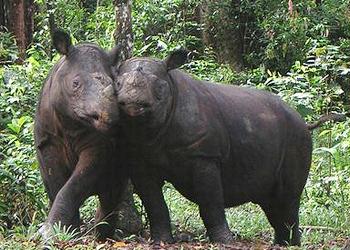
Sumatran rhinos (Photo by Dedi Candra / Yayasan Badak Indonesia)
 
The governments of Indonesia and Malaysia today agreed for the first time to collaborate on saving the Critically Endangered Sumatran rhino, the smallest and last form of the two-horned rhino in Asia that has lived on the planet for 20 million years.

The last wild populations of Sumatran rhino, Dicerorhinus sumatrensis, amount to fewer than 100 rhinos in total. They survive on the Indonesian island of Sumatra and in Sabah, Malaysia on the northern part of the island of Borneo.

The agreement was reached at the Sumatran Rhino Crisis Summit convened by the International Union for Conservation of Nature’s Species Survival Commission (IUCN SSC) at the Singapore Zoo with a wide range of international and national organizations.

Experts gathered at the summit proposed a two-year emergency action plan as an immediate follow-up to the event. The two governments now need to formalize the collaboration and agree on the next steps to tackle the Sumatran rhino crisis, brought on by an increase in illegal hunting and consumer demand for rhino horn.

Datuk Dr. Laurentius Ambu, director of the Sabah Wildlife Department, detailed some of the initiatives the two countries will take to conserve the last Sumatran rhinos.

“We would like to reiterate Sabah’s commitment and our willingness to further discuss with Indonesia opportunities to exchange reproductive cells of the species, move individual rhinos between our countries and to employ advanced reproductive technology as a parallel initiative in the Sumatran rhino captive breeding program,” he said.

Dr. Ambu made this pledge to more than 130 rhino experts, scientists, government officials and representatives of nongovernmental organizations from around the world gathered in Singapore this week to address the Sumatran rhino crisis.

They made their plans in view of lessons learned from previous conservation successes of other rhinos and species such as the Californian condor, the black-footed ferret and Hawaiian forest birds.

“Serious steps must be taken to roll back the tide of extinction of the Sumatran rhino,” said Widodo Ramano, executive director of the Indonesian Rhino Foundation, Yayasan Badak Indonesia, a nongovernmental organization.

“This could be our last opportunity to save this species and, by working together as a collaborative unit, internationally and regionally, with an agreed vision and goals, a glimmer of hope has been clearly demonstrated,” he said.

“We need to act together urgently, hand in hand, replicating some of the inspirational successes of other conservation efforts and aim to stop any failures that might impede progress,” Ramano said.

“The Sumatran Rhino Crisis Summit has been transformational by bringing together the two governments whose representatives committed to positive and proactive bilateral collaboration which is critical for saving this enigmatic species,” says Mark Stanley Price, chairman of the IUCN SSC Species Conservation Planning Sub-Committee.

“Huge progress has been made in specifying the resources needed to improve rhino surveys, security and monitoring,” said Price. “We have also explored the potential of new technologies and the role of integrating the management of wild and captive individuals.”

Summit participants were encouraged by the agreement, although the recent past history of rhinos has been bleak.


Monday, March 18, 2013

Tracking wild elephants to identify conservation areas and corridors

http://cdn.theborneopost.com/newsimages/2013/03/B5521.jpg
Dr Diana Ramirez and Marvin George from Widlife Rescue Unit collecting blood from Dara’s ear.

KOTA KINABALU: The Wildlife Rescue Unit (WRU) from Sabah Wildlife Department darted two female elephants, one adult and one juvenile in Gunung Rara Forest Reserve.

The two females were part of the herd from which 14 individuals died from unknown cause.

Dr Diana Ramirez, wildlife veterinarian for WRU, said the adult female, named Dara by WRU rangers, was set up with a satellite collar provided by Danau Girang Field Centre.

“We also collected blood from Dara and a juvenile female from the same herd, following a request by the State Wildlife Enforcement Task Force. One of the causes of death of the 14 elephants could be an emerging or unknown disease. By analysing the blood of the living elephants from the same herd, it could help identifying the disease, if any,” explained Ramirez.

Danau Girang Field Centre (DGFC) director Dr Benoit Goossens said by collaring an adult female from the herd, they hope to identify the movements of the herd within the changing landscape in Gunung Rara/Kalabakan region, and try to understand what could have happened to the 14 elephants that died last January.

“Moreover, in collaboration with WWF-Malaysia, we plan to fit satellite collars on 20 to 30 elephants from several herds in central Sabah. We will then monitor their movements and ranging patterns in order to identify the best areas for conservation and propose the establishment of elephant corridors,” added Goossens.

“So far, from February 25 to March 15, Dara has been traveling within Gunung Rara Forest Reserve. Blood samples were sent to Thailand and Australia for analysis,” concluded Goossens.

Datuk Dr Laurentius Ambu, director of Sabah Wildlife Department, said the Ministry of Tourism, Culture and Environment and the Sabah Wildlife Department would not give up in its quest of identifying the cause of death of the 14 elephants that were found in Gunung Rara Forest Reserve.

Dara’s collaring was funded by grants from The Asian Elephant Foundation and Mohamed bin Zayed Species Conservation Fund and US Fish and Wildlife Service to DGFC.

Danau Girang Field Centre ¨C a field study centre located within the Kinabatangan – is a collaborative project between the Sabah Wildlife Department and Cardiff University.

The Sabah Wildlife Rescue Unit was established by SWD with funds from the Malaysian Palm Oil Council (MPOC) and Shangri-La’s Rasa Ria Resort.

Source: Borneo Post

Friday, February 1, 2013

Figs planting to save endangered species in Borneo?

Orang utan on fig tree

Borneo and Sumatra are the only places on Earth where tigers, rhinos, orangutans, and elephants live together. The forests are home to marvelous creatures like the proboscis monkey, sun bear, clouded leopard, and flying fox bat, and endangered animals like the Sumatran tiger, Sumatran rhino, and pygmy elephant.

A research has been carried out in Maliau Basin where the researchers picked a single fig tree (Ficus caulocarpa) and surveyed the species feeding from it over a 5-day-period. According to their findings (published in Tropical Conservation Science), it shows that a fig tree over a short period of time feeds a high percentage of endangered species. This indirectly will save the Borneo's frugivores (fruit-eating species) from extinction. 

Figs produce fruit year round hence provide a constant source of fruit to frugivores. For example, studies in Borneo have found that 42 percent of known birds and 73 percent of known mammals feed on figs. But the fig-eating animals repay the trees by spreading their seeds—and genetics—across the forest.

Ecosystem health can be roughly analyzed by monitoring species at fig trees in other areas of Borneo. Figs not only provide food for wildlife but also save them from extinction. 

Frugivores are very sensitive to hunting and deforestation. Therefore, it is highly recommended to replanting figs in disturbed forest to boost fruit availability for endangered species.

Sunday, June 3, 2012

Top Five Endangered Animals in Malaysia

The population of these animals have been decreasing over the years and some are said to have become extinct.

I’m from Malaysia, a rainforest country where all types of animals are able to live together peacefully – or that was what used to happen many years ago. Now, some of these animals are under serious threat and are facing the possibility of becoming extinct.

Black Shrew
Black Shrew has rarely been seen by human and there is no official record on its size. However, witnesses have estimated the size to be 20 – 100 mm. One recorded specimen was found in Mount Kinabalu in Sabah, Malaysia. Nobody knows whether this creature has extinct or still occupy a small area in the Sabah state of Malaysia. They tend to be aggressive towards each others and are mostly solitary creatures.


Estimated number left in the world = Critically endangered. Might already been extinct.
Sumatran Rhinoceros
Sumatran Rhino is the smallest rhinoceros measuring about 250 centimeters in length and 120-145 centimeters tall (shoulder). It is also much lighter than other rhinos, weighing about 500-800 kilograms. The 2-horned rhino can normally be found in swamps and rainforests of Asia countries such as Malaysia, Thailand, Indonesia and India. However, these solitary animals are facing the threat of extinction due to the poaching of their horns.


Estimated number left in the world = 300
Malayan Tapir
Tapir is a pig-like animal with a short snout. They inhabit the forest regions of South America, Central America and South East Asia. Their closest relatives are the horses and rhinoceroses, and all 4 species have been classified as endangered. In Malaysia, only 1 of the 4 species of tapir exists – the Malayan Tapir. Tapir mainly survive on the forest’s resources such as berries, leaves and fruits. They have not many natural predators in the forest thanks to their thick skin and ability to run fast. As for Malayan Tapir, its strange body colour is often misunderstood as a large rock when lying down. This serves as a good camourflage for the creature. However, their numbers are fast declining due to their habitat loss (establishment of plantations, forest burning and logging), and the hunt for their meat and hide.


Estimated number left in Malaysia (Malayan Tapir) = about 369
Mouse Deer
Mouse Deer or better known as Sang Kancil in one of Malaysia’s folklores, is a small creature about 70 centimeters long, 30-35 centimeters tall (shoulder), and around 5-8 kilograms in weight. That’s the estimated size of the Greater Mouse Deer while the Lesser Mouse Deer species is estimated to weight around 2 kilograms. Mouse deers can only be found in Malaysia, Borneo and parts of Indonesia. They survive mostly on fruits and leaves. They are also believed to be nocturnal creatures.


Estimated number left in the world = No population estimate has been made, but has been classified as Endangered
Orangutan
There are basically 2 species of Orangutan – the critically endangered Sumatran species and also the endangered Bornean species. Both these species could only be found in the islands of Borneo and Sumatra. The name Orangutan is actually derived from the Malay language Orang Hutan which means “forest man”, due to the similarity between the Orangutans’ behavior and those of the human beings. Orangutans are very intelligent creatures, said to be the smartest creature on Earth after human. However, their numbers have been on a decline in the past few decades due to active logging activities and forest fires.


Estimated number left in the world (Sumatran species) = about 7000
Estimated number left in the world (Bornean species) = about 45000 – 69000
There are few other unique looking shrews which have already been classified as extinct due to their habitats being destroyed by human beings. I think it’s time for us to take up a more active role in helping these defenceless animals before more of them become extinct.

Read more: http://socyberty.com/activism/top-five-endangered-animals-in-malaysia/#ixzz1vZWsjnNz

Tuesday, May 22, 2012

How Eco-tourism Can Help Save Endangered Wildlife in Sabah, Borneo

Sabah, land of 'eco treasures'

Sabah, part of the Malaysian Federation of states and of the island of Borneo, attracts thousands of tourists every year. Marketed as a land of 'eco treasures', it is a place where tropical rainforest and rare species of plant and animals survive. Largely commercially unexploited until the nineteenth century, Sabah (and Borneo in general) still contains primary rainforest and, consequently, a wealth of amazing scenery and wildlife. Sustaining natural treasures while promoting economic growth is a tricky balancing act in any part of the world and Borneo is no different. Eco or conservation tourism seeks to generate income while protecting the region's most endangered species.

Forest destruction and oil palm plantation
Borneo's rich natural resources have been exploited for decades and a boom in the timber industry in the 1950s apparently created millionaires. Forest clearance has been followed in many areas by a monoculture of oil palm plantations and the past decade or so has seen the rise of another generation of millionaires who got rich by wreaking havoc on the landscape.
How much more of this destruction can Borneo take? As development and infringements on the rainforest continue the future for some wildlife looks bleak. Clearance has put inexorable pressure on forest dependent species, in particular large primates, the native Bornean orang utan. Another, smaller, primate in trouble as a result of forest clearance is the proboscis monkey, a species found only in Borneo. The fates of these animals are intertwined as habitat destruction is having huge negative impacts on both populations. Conserving the shrinking rainforest is the key to their survival.

What is the hope for the future?
Aside from preventative measures that provide protection for the forest and their inhabitants, such as the designation of national parks, perhaps the greatest hope for the conservation of the orang utan and the proboscis monkey in Borneo is the ability to generate jobs and income from the attempts to save them. This is where revenue from tourism can play a part. Two tourist destinations in particular illustrate the hope for the future; the Proboscis Monkey Sanctuary and the Sepilok Orang Utan Rehabilitation Centre, both near the city of Sandakan in eastern Sabah.

Saving a part of the mangrove forest for the proboscis monkey
The proboscis monkey sanctuary at Labuk Bay is c. 40 km from Sandakan. It is set within a huge oil palm plantation. The owners of the land became fascinated by the proboscis monkey during development of their plantation and, in 1994, decided to set aside an area of mangrove swamp as a sanctuary. The monkeys are fed twice daily and these sessions are open to tourists. It's a charming place and a truly wonderful experience to watch these monkeys interact and to hear the guides' stories about the social organisation of all the monkey groups in the sanctuary. It is also possible to stay at the centre and to go on organised wildlife watching trips. The fact that the centre can earn revenue from tourists offsets the loss of income that the owners of the plantation had to absorb when they decided not to convert all their land to oil palm cultivation. And it is not just tourists and local people who benefit, research monitoring the behaviour of the monkeys is always ongoing at the sanctuary.

A safe haven in the forest for orang utan
The Sepilok Orang Utan Rehabilitation Centre is a more established stop on the tourist trail. Just outside Sandakan, this centre was set up in 1964 to help return orphaned orang utan to the wild. Twice a day rangers distribute food to waiting orang utan who need a little bit of extra help getting their meals from the forest. The feeding time is targeted at animals that are not yet fully rehabilitated; visitors to the feeding station are often young, and still learning to fend for themselves, or mothers with babies. The feeding time is a good opportunity to view animals that are making the transition from being human dependent to wild animals. The food is kept deliberately monotonous to encourage the orang utan to forage for themselves. Over 100 animals have been rehabilitated at the centre to date. Some of the apes have been so successfully rehabilitated that they have been relocated to protected areas elsewhere in Sabah, in a bid to manage population size in the forest at Sepilok and to contribute to population growth in areas where there is room for more apes. A visit to the rehabilitation centre is an excellent way to fund the rehabilitation centre's valuable work, which focuses on saving wildlife, education and research into the orang utan, and conservation. It's also one of the best ways to guarantee a sighting of an orang utan; they are shy, elusive animals in the wild, whereas at the rehabilitation centre there are usually at least two apes at the feeding station every day.
These stories demonstrates how tourism creates hope for the future of these primates, and for the ecosystem of Borneo in general. If tourism can generate enough income and, hopefully, wealth, for its people, we can dream that there will be no need to ravage the landscape in the future, or that development can co-exist in balance with habitat conservation.


Hope for Borneo's Threatened Biodiversity


ScienceDaily (Nov. 10, 2010) — To tackle species loss representatives of the Rhino and Forest Fund (RFF) and of the Forestry Department of Sabah / Malaysia launched a long-term reforestation project to restore forest in Borneo. Borneo's unique biodiversity is threatened by deforestation and habitat fragmentation. To save endangered species like the Sabah rhino, the clouded leopard, or the orangutan, it is necessary to restore and reconnect degraded and fragmented forest land.

On Nov. 8, 2011, a Memorandum of Understanding (MoU) was signed between the Sabah Forestry Department and a German-based NGO, the Rhino and Forest Fund, giving the green light for a long-term forest restoration project in and around the Tabin Wildlife Reserve. The first trees will be planted in January 2011.  In the MoU the government of Sabah ensures that the reserve and the restored areas will remain protected, excluding any conversion or logging in the future.
The core area of Tabin remains still untouched and represents one of the oldest and most diverse rainforests in the world. The reserve is surrounded by oil palm plantations, restricting movements of large mammals. The restoration project of the Rhino and Forest Fund will increase habitat and reconnect patches of rainforest, enabling the movements and breeding of isolated populations, such as the pygmy elephant and the Sabah rhino.

The MoU was signed during the 'International Conference on Forests and Climate Change' held at the Magellan Sutera Hotel, in Sabah, Malaysia on Monday. Datuk Sam Mannan, Director of the Sabah Forestry Department stated during the conference: "Forests are important for Sabah's climate and its rich biodiversity. They provide fundamental services to human well beings and therefore need to be protected and restored."

The Rhino and Forest Fund aims to save biodiversity by reforesting degraded and fragmented habitat and has a special focus on the nearly extinct Sabah rhino (Dicerorhinus sumatrensis harrissoni). The RFF gets scientific advice from the Leibniz Institute for Zoo- and Wildlife Research (IZW) Berlin, Germany and funding from the Zoo Leipzig in Germany.

Dr. Petra Kretzschmar, co-founder of the German-based NGO stated: "We see the charismatic Sabah rhino as a flagship species for the diverse lowland rainforest in Sabah. The signing is a major breakthrough to effectively combine the protection of endangered species like the rhino and the restoration of their natural habitat."

Robert Risch, co-founder of the Rhino and Forest Fund concluded: "Our reforestation project will support Sabah's outstanding efforts to preserve its extraordinary biodiversity for future generations. Sabah is a hotspot of biodiversity and therefore of global significance. If Sabah loses species, the whole planet will become poorer. So there should be global awareness, cooperation and action on an international level to stop species loss.“

The restoration work will start in early 2011 and will be expanded during the next years.


Wednesday, February 8, 2012

Endangered wildlife can have easier migration

KOTA KINABALU: A move is under way to connect the country's largest wildlife forest reserve, Tabin, with adjacent fragmented forests through wildlife corridors in Sabah's east coast Lahad Datu.

The move will facilitate the migration of critically-endangered wildlife through the newly established Segama Corridor Conservation Area.

Conservationists hope it would eventually lead to a narrow but continuous corridor from Tabin to Kulamba Wildlife Reserve, another important refuge for endangered species on the northern side of the Dent peninsular in Lahad Datu.

The Sabah Wildlife Department (SWD) and the German-based conservation non-governmental organisation Rhino and Forest Fund (RFF) signed an agreement to improve a wildlife corridor between the isolated Tabin reserve with adjacent conservation areas recently.

Tabin Wildlife Reserve is one of the last areas on the Borneo island where large wildlife still coexist, including the Bornean Rhino, Bornean Elephant, Orang Utan, Banteng and Sun Bear.

“Connecting forest fragments is an integral part of our strategy to secure wildlife habitat in the long term,” Wildlife Department director Dr Laurentius Ambu said.

He said it was necessary for the department to be active in promoting the reforestation work throughout areas with wildlife as corridors and forest patches are much needed for wildlife connectivity.

“At present, there is an increase of reforestation work within wildlife landscapes in Sabah and we want them to be successful not only for the benefit of wildlife but also local communities who live close to these areas,” said Laurentius.

“To save endangered wildlife suffering from habitat fragmentation, we need to establish a network of protected areas of a sufficient size and quality.

“This will prevent inbreeding of currently separated sub-populations and help to maintain healthy population.”

RFF director Robert Risch said the outcome of their efforts would be a connected conservation area of more than 200,000ha, nearly twice as big as Tabin is today.

Leipzig Zoo from Germany and private donors financially support this reforestation project.

Source: http://thestar.com.my/news/story.asp?file=/2012/2/7/nation/10689827&sec=nation

Green Sabah says:  Today with the help of NGO’s, not-for profit organizations and governments world-wide there is a stronger movement taking place, with a deeper understanding of habitat conservation with the aim of protecting delicate habitats and preserving biodiversity on a global scale. The commitment and actions of volunteering association is paramount in ensuring generations that follow understand the importance of conserving natural resources.