Showing posts with label Sustainable Farming. Show all posts

Tuesday, January 22, 2013

10 Practices of Sustainable Farming

Sustainable Farming
Sustainable agriculture is the act of farming using principles of ecology, the study of relationships between organisms and their environment. It has been defined as "an integrated system of plant and animal production practices having a site-specific application that will last over the long term:
  • Satisfy human food and fiber needs
  • Enhance environmental quality and the natural resource base upon which the agricultural economy depends
  • Make the most efficient use of non-renewable resources and on-farm resources and integrate, where appropriate, natural biological cycles and controls
  • Sustain the economic viability of farm operations
  • Enhance the quality of life for farmers and society as a whole
[Source: Wikipedia]

Below are the 10 practices that lead to sustainable farming.

1: Use of Alternative Energy

Basically, solar and wind energy are the most known alternative energy. However, some forms of alternative energy can be generated base on the location of the crops. For instance, hydroelectric power might be an option for larger farms near a source of running water. Bio-fuels are another clean source of energy which can be manufactured from cottonseed oil, and it's not only a cheap source of energy, but also a very clean one. 


2: Growing to Sell Locally

Growing and buying locally is key to sustainability, as it enriches the community, minimizes energy consumption, and protects air and soil quality. It also encourages farming in a small scale, so you can have faster turnovers. This in turn pushes more money into the local economy, benefiting the buyers and eventually the farmers again.When grow and sell in the same town, and you won't have to worry about the pollution created by having to transport, package and store crops.


3: Management of Water

There are two common problems in water management in farms: the poor performance of irrigation systems and water waste. Inefficient irrigation systems can deplete rivers, degrade soil and affect wildlife. So, one must ensure the irrigation systems work efficiently. Some farms even set up recycling systems in order to reuse municipal waste water for irrigation. The best way to manage water usage in farms is to choose native crops, select drought-tolerant crops and mulching. 


4: Physical Removal of Weeds

This might be impractical for large farms, smaller crops can easily be taken care of without the use of chemicals. Hand removal is labour intensive and usually only reserved for specific areas machines can't reach or where the crops are too fragile. Most of the physical removal of weeds is done through the use of agricultural machinery or tools. Mowing and grazing are especially effective before weeds produce seeds. Not only does this prevent the weeds from reproducing, but the weeds can also become mulch if not removed. Burning old crops is also an option, but one that should be approached carefully. Not only can burning damage the soil and the local wildlife, but it's also dangerous to the workers. 


5: Managed Grazing

Managed grazing is basically a livestock rotation that moves animals to graze in different areas. Managing their grazing by moving them around will ensure better exposure to a variety of plants, and it also means less erosion because you don't have the animals tromping over the same area of land over and over. Besides, it also helps with weed control and soil fertility. Natural fertilizer can be 'produced' from the manure left behind.  


6: Soil Fertility

Soil healthy is very crucial since the crops get most of their nutrients directly from the soil. Tillage practices, which consist of plowing, turning and airing the soil, have been around for centuries and are still as useful as ever. Many farmers leave some crop residue on the ground before they till to add to the richness of the soil. Adding organic matter, such as manure or cover crops, can also help the soil. Other organic compounds that can be added to the ground as fertilizers include alfalfa meal, wood ash, animal byproducts, rock and mineral products, and alumino-silicate materials. 


7: Attracting Beneficial Animals

To get rid of  pests and harmful insects is to invite in their natural predators. Bats and birds are the two most obvious choices. Both typically stick around if they have a place to nest. Meanwhile, organic pest control is to ensure that beneficial insects also stick around. Ladybugs, beetles, green lacewing larvae and fly parasites all feed on pests, including aphids, mites and pest flies. 


8: Integrated Pest Management

It is the combination of different techniques to create an effective pest control system.The first step is monitoring and identifying pests. Not all pests need to be eliminated. By using techniques like choosing pest-resistant crops, rotating crops and using beneficial insects, the risk of pests settling in is smaller. Prevention is also part of integrated pest management.When it's time to attack pests, targeted spraying is best. 


9. Crop Diversity

These variations ensure genetic diversity, which makes the crops stronger. To help protect their crops against disease and pests, farmers can plant variations of the same species, getting seeds from different growers to ensure small but important differences among the plants.


10: Crop Rotation

Last but not least, crop rotation. It is probably the oldest and simplest system used to maintain the health of soil. While it might not seem so to the non-farming community, crop rotation has a logical order, chosen so the crops planted today can help replenish the nutrients that the previous crops depleted from the soil. In most cases, the system is simple: Plant grains after legumes or row crops after grains.

[Source: discovery.com]

Thursday, January 3, 2013

Steps to Sustainable Agriculture

(example)

Sustainable agriculture and organic farming aim to use practices which are more ecological. Many people confused with both terms. Although they have the same objective, there are certain set of standards to differentiate them.  Below are some of the steps to farm with sustainable methods.

Understand that being certified organic doesn't guarantee sustainable practices. What an organic label means is that the food was grown or raised without the use of synthetic chemicals (but there are exceptions). Organic farming, especially when carried out on a large, industrial scale, can still damage the environment and threaten public health in a variety of ways: Ecosystems can still be ruined by widespread monoculture; pesticides can still be applied; soils can still be depleted of nutrients and organic matter; pollution can still be created; and exorbitant amounts of fossil fuels can still be spent (and wasted), all under an organic label 

Become familiar with how sustainable agriculture is defined: Farming a single area so that it produces food indefinitely. In order to move in this direction, a farm has to avoid irreversible changes to the land (for example, erosion), withdraw no resources from the environment that cannot be replenished (for example, not using more water than can be replaced regularly by rainfall), and produce enough income to remain a farm in face of worldwide farm consolidation and infrastructure development.

Consider the source. Where are your resources and inputs coming from? Think specifically about water, energy, soil amendments, and feed (if you have livestock). Also think about long-term, capital investments, such as structural building materials, tools, etc. Determine where your resources come from and whether you're taking more than can be replaced, either through natural processes or your own practices. Keep in mind that no farm is an island: complete self-sufficiency is not a requirement of sustainable agriculture. Long-term stability and productivity is. The more renewable and varied your resources are, the longer your farm will last.

Eliminate waste. There is no "away" to "throw" to. Everything is connected. The three "R"s apply here more than ever: reduce, reuse, recycle. It'll not only be more sustainable, but it's cheaper, too. Examine every bit of garbage and waste that your operation produces and ask "What else can I do with this?" If you can't do anything to do with it, try to think of ways someone else in the community can use it. Be creative.

Diversify ecologically. Choosing "polyculture" over "monoculture" results in less waste and often, reduced fossil fuel consumption. 

Diversify financially. An ecologically sustainable farming operation won't do anybody much good if it can't generate a profit and keep itself running. Unless you or someone else is willing and able to sponsor the farm with an off-farm day job or another external source of income, you're going to have to crunch the numbers until you're in the black.  

Find good, reliable labor. This is the most important and quite possibly your most difficult task. A reduced dependence on fossil fuels means an increased dependence on human labor, and not just physical, manual labor––you're going to need knowledgeable workers who understand the complexity of the system you're running and can enhance it with every decision they make. Find people who are committed to sustainable agriculture (not just dabbling in it) and who aren't afraid to get their hands dirty as they apply their minds.

Enjoy your life. Farming is hard work, but the most successful farmers know when to call it a day and circumvent burnout. Remember why you're farming and why, in particular, you're aiming for a sustainable operation. For most people, it's because they like knowing they're leaving land in better shape than they found it.

Read more: http://www.wikihow.com/Practice-Sustainable-Agriculture

Thursday, September 13, 2012

All Saints Secondary School’s sustainable farming effort sets a good example

KOTA KINABALU: Talks of green living and eating healthy food are becoming hot topics among people, especially health and figure conscious individuals.

Many are opting for sustainable farmed organic food, and lean meat instead of pesticide contaminated vegetables or hormone injected farm animals for their daily dietary supplement.

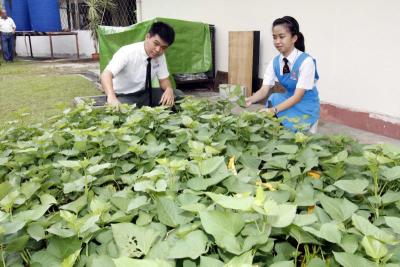
Realising the importance of cleaner food, air and environment, one teacher, Wong Foo, from the All Saints Secondary School near here have set up a horticulture club to promote sustainable farming.

 The physics teacher came up with an idea of changing the school’s landscape into a “gardenscape” concept early April last year, and gathered several pioneer members to assist him.

“The students and I started off small, and planted vegetables at a small piece of land behind the school without using pesticides or chemical fertilizers,” he said during the launch of the horticulture club last week.

“It was hard at first because resources were limited and our manpower was small, but after a few months, our first few patches of vegetables grew magnificently and I decided to expand this initiative by starting a club (unofficially) in January this year,” Wong said.

Since then, over 40 students from the Forms 4 and 5 Science classes have worked hand in hand to plant more vegetables in the school compound, with an accumulated plantation area reaching about half an acre now.

This effort had also attracted the Sabah Environmental Protection Association (SEPA) and the Environment Action Commission (EAC) to help the club members and school in their sustainable farming programmes.

In this respect, club president Ricky Wong said the sustainable farming in the school was made possible because of the support from students and teachers.

“We started with the preparatory stage, then maintaining the vegetable patch so they would grow well for harvesting, and lastly to be sold among school teachers and parents,” he explained.

Ricky said the teachers have also shown support by advising them on how to go about the project and bought the vegetables when they were ready for harvest.

He said fertilizers were self-made using carbon, rice bran, chicken dung and molasses.

“The process to make these fertilizers take about two weeks, whereas vegetables which are planted on rotation basis take about one to three months to grow, depending on the type of vegetables,” he said.

The types of vegetables planted include spinach, Chinese cabbage or bak choi, yam, bittergourd and baby kailan.

Wong said they also plant flowers around the vegetables so that insects and other pests would nibble on the flowers instead of the vegetables to keep them fresh and edible.

Meanwhile, Tourism, Culture and Environment Ministry permanent secretary, Datuk Michael Emban who represented the minister, Datuk Masidi Manjun hopes the programme continues and spreads on to other schools.

“This is an area which the ministry is responsible, so we will definitely support these initiatives with the hope that other schools will emulate,” he said.


Source: http://thestar.com.my/metro/story.asp?file=/2012/9/13/southneast/12007547&sec=southneast
Picture source: thestar.com.my

Sunday, May 13, 2012

Farm Project at SK St Francis Convent, KK

Sustainable Farming at SK Convent St. Francis, Kota Kinabalu


President of SEPA Wong Tack, Secretary Paul Chang and Consultant of the project Shum went to SK St Francis Convent to witness the corn harvest of the sustainable farming that was started few months ago


The farm project yield a good quality corn harvest.


Headmistress Sim Cho Kein, teachers and students join together to harvest the organic corn and taste the first hand quality.

Wong Tack and Paul also gave few organic corn yield for sampling to the Ministry of Tourism, Culture and Environment Sabah YB Datuk Masidi Manjun and his Permanent Secretary Datuk Michael Emban


SEPA would like to thank to SK St Francis Convent Headmistress Sim Cho Kein, Teachers and Students for their good respond of this sustainable farm project and hope the health awareness of organic vegetables benefits can be applied to their everyday life

Source: http://wikisabah.blogspot.com/2012/05/farm-project-at-sk-st-francis-convent.html