Friday, May 11, 2012

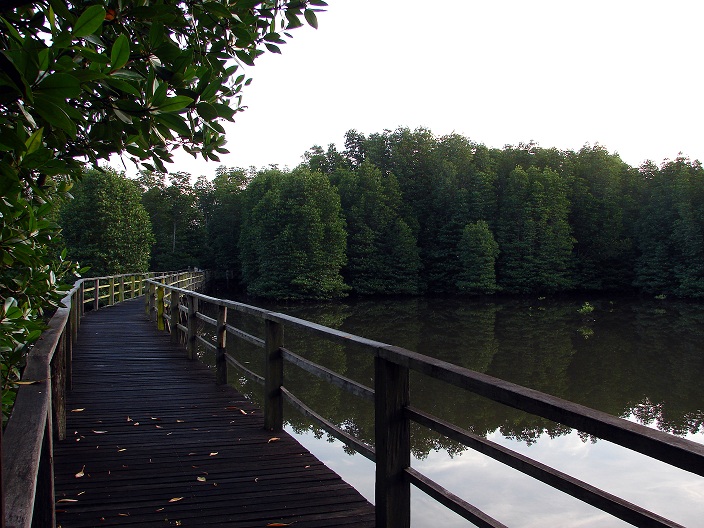
Japanese Students in Mangrove Planting Project

A group of secondary students from Japan has volunteered to come to Sabah for the first time to plant mangroves and even donated RM3,500 in support of the State’s project on rehabilitation of degraded mangroves.
State Forestry Department (SFD) Director Datuk Sam Mannan said the group of students from Ritsumeikan Uji High School in Kyoto was brought by Professor Shigeyuki Baba, Executive Director of the International Society for Mangrove Ecosystem (ISME).
He said the trip to Sabah was in conjunction with the third meeting of the Project Steering Committee on rehabilitation of degraded mangroves that was held in Sandakan yesterday.
It was part of the collaboration between SFD and ISME that was sealed on November 10, 2010 to implement the rehabilitation project.
Sam said the students, led by their teacher Saori Matsuoka, were all excited about the trip and took part in planting mangroves in Sungai Lalasun, Sandakan.
He added that from the funds raised for the trip, the students donated 10,000 Yen (more than RM3,500) to SFD in support of mangrove rehabilitation in the State.
Recognising the importance of cultural exchange and nature education, the students visited SMK Muhibbah Sandakan, the Orang Utan Rehabilitation Centre and the Labuk Bay Proboscis Monkey Centre.
Sam said the collaborative project between SFD and ISME is funded by Tokio Marine & Nichido Fire Insurance Co. Ltd, and the first phase of the project would be for three years (2011-2014 with an annual target of 50 hectares.
He said the ISME had remitted RM206,300 to SFD to support the expenditures of rehabilitation work for the first year and from October 2011 to March 2012, the project had planted 50 hectares of degraded mangroves in forest reserves of Sandakan and Beaufort.
The PSC was formed and chaired by the Director of SFD to monitor the progress of the project, and thus far, the committee had met three times in Sandakan.
ISME was established in 1990 to promote research, conservation, rational management and sustainable use of mangrove ecosystems. With its Secretariat located at the University of the Ryukyus, Okinawa, Japan, the society now has over 1000 members from 90 countries/regions.
During the Society’s 8th General Assembly and Mangrove Workshop in Sandakan in September last year, SFD was awarded an honorary institutional membership of ISME.
Sam said such collaboration presented a great opportunity for SFD to strengthen its capacity in mangrove rehabilitation.
“SFD is honoured to be chosen by the Society for the project implementation.
“Sabah is the first state in Malaysia to have such collaboration with ISME and this may herald the beginning of other collaborative efforts between institutions in Japan and Sabah in the future,” he added. 

Source: http://kepkas.sabah.gov.my/2012/03/20/japanese-students-plant-mangroves-to-support-rehabilitation/

Photo Source: http://www.borneotourstravel.com/sabah-history/kk-city-bird-sanctuary/

Melapi Elephant Corridor

The fragmentation of the forest habitats is one of the key challenges to ensure the survival of the Bornean elephants in Sabah. The ‘Melapi elephant corridor’ in Sukau has proven that even a strip of land 50 meters wide makes a difference to facilitate the migration of the Bornean elephant herds in Lower Kinabatangan.
The conservation project, led by Raymond Alfred, the head of Conservation and Research, Borneo Conservation Trust (BCT), explained that the corridor was established in August 2011 which is a collaboration between the Sabah Wildlife Department and Borneo Conservation Trust, together with their partners Syarikat Yu Kwang Development Sdn. Bhd. and Proboscis Lodge Bukit Melapi.
The Borneo Conservation Trust (BCT) is a non-profit NGO established in 2006 and was incorporated under the Trustee’s Ordinance 1951, Cap. 148 (Sabah).
BCT relies wholly on funds and grants that is provided by individuals and corporations, to enable it to implement conservation and research works.
The establishment of the Borneo Conservation Trust (BCT) was first mooted as an unprecedented Malaysia-Japanese effort to re-acquire the important alienated lands in the wetlands and riverine forests in order to allow the movements of Bornean elephants and orang utans, the flagship species of Sabah.
“We are very happy to know that the elephants are now able to pass through the land using this corridor to migrate from one key habitat to another, when previously it was a very narrow bottleneck,” said Alfred.
“This collaborative effort is an example where the private sector can work with us and the NGOs. We welcome the opportunity to work hand-in-hand with companies and organisations keen to play an active role in supporting and contributing to Sabah’s wildlife conservation initiatives,” said Dr Laurentius N. Ambu, the director of the Sabah Wildlife Department.
“With the re-establishment of this corridor, the potential human and elephant conflict in the villages and plantations is also reduced,” concluded Ambu.
This week, students from the Nihon University Japan, planted more than 100 trees within this corridor to facilitate the movement of the orang utans within the fragmented habitat in the future.
The activities of the students were coordinated by Borneo Conservation Trust Japan (BCT-Japan).
With continuous diligent effort in the next three years, a forest canopy could be eventually established in the area. 


Source: http://kepkas.sabah.gov.my/2012/03/20/elephants-using-survival-corridor/

Photo Source:  http://true-wildlife.blogspot.com/2011/01/borneo-elephant.html

Sabah first Primatologist

A local Sabahan, Andy Martin Ginal Martin, has become the first fully qualified primatologist in the State. Martin, a research assistant at Sepilok, underwent a two-year course at Oxford Brookes under the full sponsorship of the Orangutan Appeal UK and has already received accreditation from the university.
When interviewed at the Sepilok Orangutan Appeal UK cocktail party at Rasa Ria Resort recently, Martin said that as a Sabahan, he felt the education he gained was important to further his expertise in the field.
“For now in Sabah, there is no one doing this private conservation. We are Sabahans, we have the orang utans and we still depend on people from the UK and elsewhere to conduct studies for us,” he said.
He acknowledged the Appeal for their role in making his graduation a reality.
“I wouldn’t be able to do it without their support because financially it was impossible to continue with my study for more than one year in the UK.” 

Martin said among the important things he had learnt from his academic stint is that he needs to look at conservation from the point of view of education.
“We need to send the conservation message to the world because now in Sabah, we have a lot of programmes but educationally, we still need outside experts to explain the knowledge,” he explained.
As a primatologist, he also commented on the survival of the orang utan in Sabah.
He said that he believed the orang utan in Sabah still have a future and it is crucial for everyone to work together and cooperate to accomplish the objectives and researches in the field.
Martin also said that the most urgent need for the survival of the species now is to protect the forest, the habitat and their population in the wild.
“There is also an urgent need to reduce deforestation,” he said.
Meanwhile, Sue Sheward, the founder and chairperson of Orangutan Appeal UK, said that it is important for Sabah to have its own people as primatologists.
She commended Martin for his tenacity in continuing with his study despite the disasters that befell upon his family.
“In the midst of it, his family house was razed by fire and his father suffered serious burns and was very ill, but Andy went on.
“He received an extension and was able to complete his degree. We are glad that now he has passed his degree and is the first Sabahan to be a qualified primatologist and I feel he will make a difference,” she said. 


Photo Souce:  http://www.orangutan.org/

Thursday, May 10, 2012

Traders give out burgers in front of Ambiga’s house


By SHAUN HO

KUALA LUMPUR: Traders upset over their loss of income during the Bersih 3.0 rally held a symbolic protest outside Bersih co-chairman Datuk S. Ambiga's house by giving away free burgers.
Several members of the Malaysia Small and Medium Entrepreneurs Alliance (Ikhlas) set up a burger stall outside Ambiga's home in Bukit Damansara on Thursday afternoon and demanded she repay their losses.
They gave away about 200 burgers during their hour-long protest.
Ikhlas is among a number of business associations who are claiming for losses suffered by their businesses due to the rally on April 28 demanding clean and fair elections.
Ikhlas president Mohd Ridzuan Abdullah said Ambiga was given two weeks to respond to their demands or he would come back with more traders to protest.
“We are still collecting claims from businesses affected from Bersih 3.0. About 200 traders have submitted about RM200,000 worth of claims. We are also claiming RM817,205 from Bersih 2.0 and the Patriot group,” said Ridzuan when contacted.
Ambiga challenged the traders to file their claims in court instead of holding protests outside her house.
“Let the court decide the matter,” said Ambiga, a former Bar Council president, when met at her house.
She added that the protest was a troubling new phenomenon and was a violation of her privacy and home, and wanted the authorities to take note.
“They have to learn that Bersih is not about me. They have to contend with many more people,” added Ambiga.
She later lodged a police report at the Travers police station. 


Green Sabah says: This is not related to environment but I just have to share it. I have never been supportive of demonstrations especially with the violent outbreaks during the KL Bersih Demonstration. I always feel that demonstration is not the way to solve any problems. This really funny and it totally makes my day.

Overfishing Large Sharks Impacts Entire Marine Ecosystem, Shrinks Shellfish Supply


ScienceDaily (Mar. 29, 2007) — Fewer big sharks in the oceans mean that bay scallops and other shellfish may be harder to find at the market, according to an article in the March 30 issue of the journal Science, tying two unlikely links in the food web to the same fate.

A team of Canadian and American ecologists, led by world-renowned fisheries biologist Ransom Myers at Dalhousie University, has found that overfishing the largest predatory sharks, such as the bull, great white, dusky, and hammerhead sharks, along the Atlantic Coast of the United States has led to an explosion of their ray, skate, and small shark prey species.
"With fewer sharks around, the species they prey upon -- like cownose rays -- have increased in numbers, and in turn, hordes of cownose rays dining on bay scallops, have wiped the scallops out," says co-author Julia Baum of Dalhousie.
"This ecological event is having a large impact on local communities that depend so much on healthy fisheries," says Charles Peterson, a professor of marine sciences biology and ecology at the Institute of Marine Sciences, University of North Carolina at Chapel Hill and co-leader of the study.
The research builds upon an earlier study by Myers and Baum, published in Science in 2003, which used data from commercial fisheries to show rapid declines in the great sharks of the northwest Atlantic since the mid-1980s. Now, by examining a dozen different research surveys from 1970-2005 along the eastern U.S. coast, the research team has found that their original study underestimated the extent of the declines: scalloped hammerhead and tiger sharks may have declined by more than 97 percent; bull, dusky, and smooth hammerhead sharks by more than 99 percent.
"Large sharks have been functionally eliminated from the east coast of the U.S., meaning that they can no longer perform their ecosystem role as top predators," says Baum. "The extent of the declines shouldn't be a surprise considering how heavily large sharks have been fished in recent decades to meet the growing worldwide demand for shark fins and meat."
Sharks are targeted in numerous fisheries, and they also are snagged as bycatch in fisheries targeting tunas and swordfish in both U.S. and high seas fisheries. As many as 73 million sharks are killed worldwide each year for the finning trade, and the number is escalating rapidly.
Ecologists have long predicted that the demise of top predators could trigger destructive consequences. Researching such effects, however, has been a challenge.
"This is the first published field experiment to demonstrate that the loss of sharks is cascading through ocean ecosystems and inflicting collateral damage on food fisheries such as scallops," says Ellen Pikitch, a professor at the University of Miami Rosenstiel School of Marine and Atmospheric Science and executive director of the Pew Institute for Ocean Science. "These unforeseen and devastating impacts underscore the need to take a more holistic ecosystem-based approach to fisheries management."
As great shark populations plummeted, their elasmobranch prey--rays, skates, and smaller sharks--increased considerably, according to research surveys looking at the past 16 to 35 years. Cownose rays are most conspicuous among the 12 species showing increases because of their near-shore migrations. With an average population increase of about eight percent per year, the east coast cownose ray population may now number as many as 40 million. The rays, which can grow to be more than four feet across, eat large quantities of bivalves, including bay scallops, oysters, soft-shell and hard clams, in the bays and estuaries they frequent during summer and migrate through during fall and spring.
In the early 1980s when Peterson sampled bay scallops in North Carolina sounds in late summer before and after the cownose rays passed through, he found that most scallops survived the ray predation, allowing the scallop population to support a fishery and still replenish itself each year. In contrast, sampling by Peterson and co-author Sean Powers in recent years--after the cownose ray population explosion--showed that the migrating rays consumed nearly all adult bay scallops in the area, except those protected inside fences that the researchers had put up to keep the rays out. By 2004, cownose rays had completely devastated the scallop population, terminating North Carolina's century-old bay scallop fishery.
"Increased predation by cownose rays also may inhibit recovery of oysters and clams from the effects of overexploitation, disease, habitat destruction, and pollution, which already have depressed these species," says Peterson, noting shellfish declines in areas occupied by cownose rays and examples of stable or growing shellfish populations in areas beyond the ray's northernmost limit.
Ecosystem effects of increases in the other ray, skate, and smaller shark species are unknown, but like the cownose ray, may also be cascading down to species lower in the food web.
"Despite the difficulty of piecing together ecosystem impacts of overfishing," co-author Travis Shepherd of Dalhousie emphasizes, "the real challenge will be to move beyond retrospective analyses and instead prevent ecosystem-wide changes from happening in the first place."
"Our study provides evidence that the loss of great sharks triggers changes that cascade throughout coastal food webs," says Baum. "Solutions include enhancing protection of great sharks by substantially reducing fishing pressure on all of these species and enforcing bans on shark finning both in national waters and on the high seas."
"Maintaining the populations of top predators is critical for sustaining healthy oceanic ecosystems," says Peterson. "Despite the vastness of the oceans, its organisms are interconnected, meaning that changes at one level have implications several steps removed. Through our work, the ocean is not so unfathomable, and we know better now why sharks matter."
This research is a contribution of the Pew Global Shark Assessment, funded by the Pew Institute for Ocean Science. The study also was supported by the Killam Trusts, the Natural Sciences and Engineering Research Council of Canada, the North Carolina Fisheries Resource Grants Program, the University of North Carolina Institute of Marine Sciences, the Sloan Census of Marine Life, and the U.S. National Science Foundation. 


Green Sabah: Every living things have their own purpose in the ecosystem, sharks may be fearsome and dangerous animal but they do serve an important role in the marine ecology. Therefore there is need to protect them to prevent them getting extinct as this will affect the ecosystem badly.